On the Links Between Truth Discovery and Bipolar Argumentation
Main idea is to explore the relation between truth discovery and argumentation in different forms:
Bipolar argumentation (main focus)
Ranked/gradual/weighted argumentation. Also called acceptability semantics (?)
Trust in argumentation
Combinations of the above
Existing work
Bipolar argumentation
Papers:
On the Acceptability of Arguments in Bipolar Argumentation Frameworks
Bipolarity in argumentation graphs: Towards a better understanding
Modular Semantics and Characteristics for Bipolar Weighted Argumentation Graphs
Evaluation of Arguments from Support Relations: Axioms and Semantics (Note: this is not really bipolar since it looks at settings with only the support relation)
Overview:
Augments Dung’s framework by considering a support relation between arguments
Support represents a positive interaction, in contrast to the attack relation which represents a negative interaction
In Dung’s framework any notion of support must be derived from the attack relation, so that attack and support are dependent notions. In bipolar argumentation, support and attack are independent
[CLS05b] argues that there are situations where two independent notions are needed to correctly formalise the argumentation process
Ranked/gradual argumentation
Papers:
Modular Semantics and Characteristics for Bipolar Weighted Argumentation Graphs
Interpretability of Gradual Semantics in Abstract Argumentation
Evaluation of Arguments from Support Relations: Axioms and Semantics
From fine-grained properties to broad principles for gradual argumentation: A principled spectrum
Different to the above, but still “ranking” arguments/extensions somehow:
Social abstract argumentation is particularly worth talking about, since it considers arguments put forward by ‘sources’ with votes for and against the arguments. However, they consider all the participants to be equally important, so their approach is not directly applicable.
Plan for the paper
Discuss link between TD and argumentation
Why bipolar argumentation in particular?
Why gradual argumentation?
Figure out how to construct a bipolar AF from a TD network
Look at semantics in BAFs - First “binary” semantics, then ranked ones
Translate these semantics to TD operators
Try to characterise them from the TD side
Axioms:
Check TD axiom satisfaction for these new operators defined from argumentation semantics
Check correspondences between our TD axioms and ranked argumentation semantics
e.g. if a semantics satisfies axiom X for argumentation then it satisfies axiom Y for TD (and vice versa)
Do axioms for semantics inspire new axioms for TD?
Can TD axioms be given argumentation-based formulation in our special type of BAFs?
TD and argumentation
Briefly on truth discovery and argumentation:
TD is concerned with determining what to believe amongst conflicting claims
Judgement is made based on interaction between claims
Argumentation already studies with how conflicting (attacking) arguments interact, and how to draw reasonable conclusions
Therefore, argumentation techniques could be useful for truth discovery
What are the arguments?
Two broad approaches:
structured argumentation, where arguments are build from a knowledge base of sentences in a formal language, and attacks are defined based on the structure of such arguments
abstract argumentation, where the nature of the attack relation and the arguments themselves are left unspecified
I have not seen any TD work in a logical setting, so abstract argumentation is more applicable to the existing literature
That is not to say that TD is not suited to a logical and structured argumentation treatment
It is tempting to just consider arguments of the form “\(f\) is the true fact for object \(o\)”. But…
The AF would need to be augmented to keep track of which sources put forward arguments
Source trust would need to be defined in some other way separate from the argumentation
There would be no symmetry between trust and belief, whereas our Coherence axiom says there should be symmetry
So maybe there should also be arguments of the form “\(s\) is a trustworthy source”
Relation between sources and facts (and hopefully trust and belief) is directly encoded in the AF
Dung or bipolar framework?
Classically only attacks between arguments are considered
In our basic TD model, it is possibly true that support from source \(s\) for fact \(f\) is the same as \(s\) attacking every other fact \(g\) with \(\obj(f)=\obj(g)\)
This is only the basic TD model though. E.g. for “multi-truth” settings, believing \(f\) doesn’t imply not believing \(g\)
However for the opposite relation (from facts to sources), a separate notion of support is surely needed
See Fig. 1…
Clearly \(f\) “attacks” \(t\) but not \(s\) or \(u\). However, \(s\) and \(u\) clearly have a different relationship with \(f\): \(s\)’s trustworthiness is supported by belief in \(f\), whereas \(u\) is unrelated.
Note that attack is still needed, e.g. between \(f\) and \(g\) in Fig. 1.
Therefore, bipolar argumentation frameworks are suitable

Figure 1
Which semantics should be used?
Broadly we have extension-based semantics which give a “binary” valuation (in/out) or gradual/ranked semantics which take a more fine-grained approach.
Semantics can be defined:
directly from the BAF
by converting the BAF to an AF either by adding new attacks or constructing “meta-arguments” [BGvdTV10]. Dung’s semantics can be applied there, and the extensions converted back into arguments from the original BAF.
Constructing a bipolar AF from a TD network
First, recall the definition of an abstract bipolar argumentation framework.
Definition (Abstract bipolar argumentation framework [CLS05b])
An abstract bipolar argumentation framework (BAF) is a tuple \(\baf\) where \(\args\) is a set of arguments and \(\attack, \supp \subseteq \args \times \args\) are binary relations on \(\args\), called the attack and support relations respectively.
Any TD network induces a BAF. (TODO: need to justify this definition. One could imaging several ways of constructing a BAF from a TD network: why is this definition a good choice?)
Definition
Let \(N = (V, E)\) be a TD network. The associated BAF is \(\baf\) where
\(\args = \S \cup \F\)
\(x \attack y\) iff \(x, y \in \F, x \ne y\) and \(\obj_N(x) = \obj_N(y)\)
\(x \supp y\) iff \((x, y) \in E\) or \((y, x) \in E\)
That is, attacks are between mutually conflicting facts, sources support the facts they claim, and facts support the sources claiming them.
Note that such BAFs contain cycles, whereas some semantics assume BAFs are acyclic (e.g. [CLS05b], [CLS05a], and to some extent [MN18]).
Note that sources and facts are themselves arguments according to the above definition. An argument \(s \in \S \subseteq \args\) should be interpreted as “\(s\) is a trustworthy source”, and an argument \(f \in \F \subseteq \args\) should be interpreted as “\(f\) is a true fact”.
Examples of a TD network and its induced BAF are shown in figures 2 and 3.
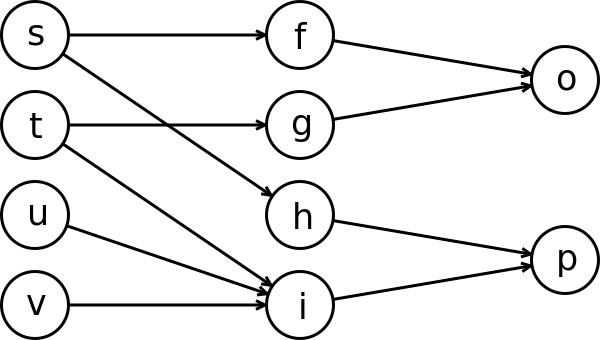
Figure 2: example TD network
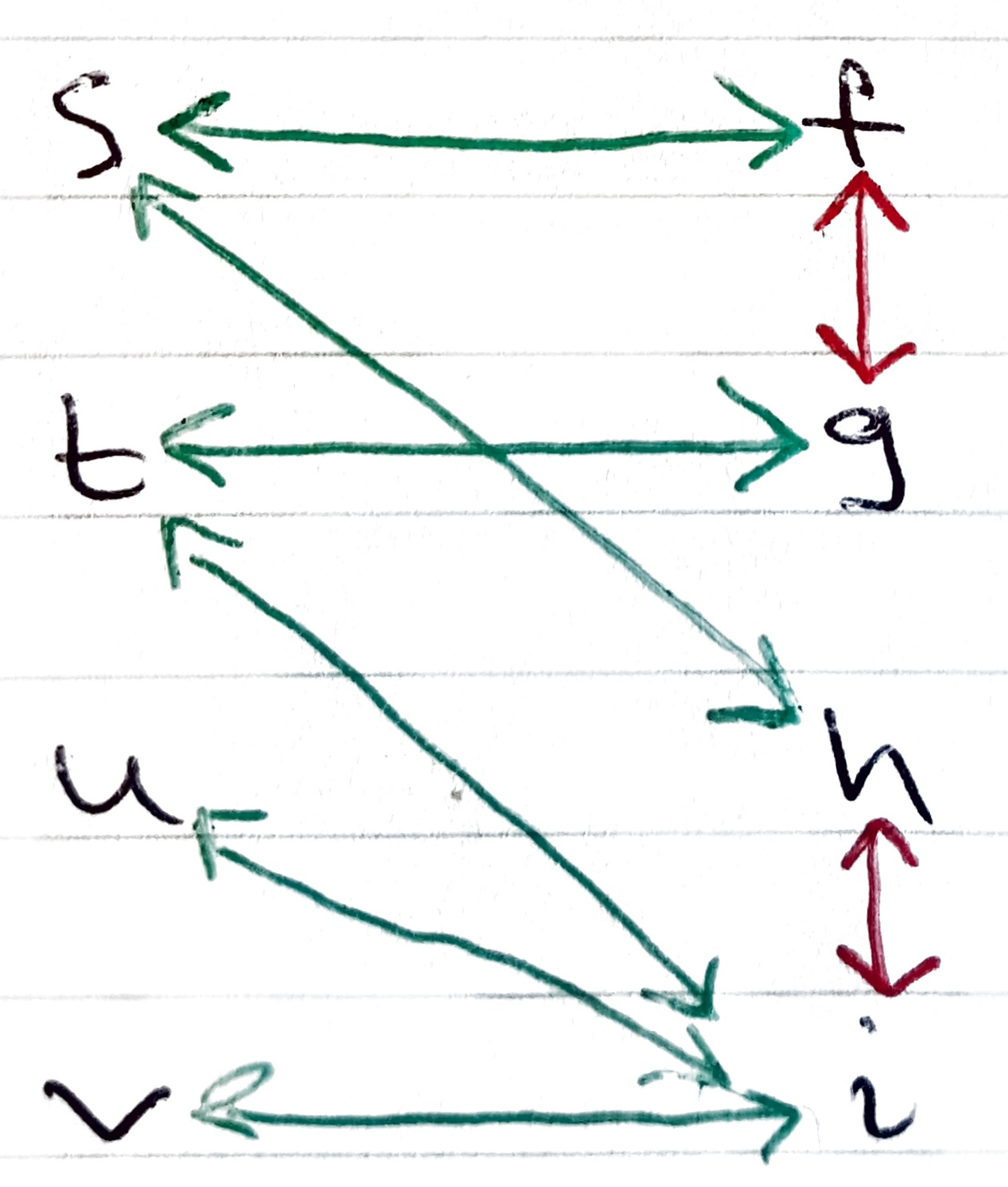
Figure 3: BAF induced by the network in Fig. 2. Attacks are shown in red, and supports in green.
Argumentation semantics
Classically, argumentation semantics select special subsets of acceptable arguments called extensions. An alternative approach is gradual or ranked argumentation, which takes a more fine-grained view and either assigns an acceptability degree to arguments, or ranks the arguments in terms of their acceptability. First we consider extension-based semantics for bipolar argumentation.
Extension-based semantics
One approach to defining semantics for BAFs is to convert the BAF to a (non-bipolar) Dung AF by introducting new complex attacks derived from the attack and support relations in the BAF. Standard semantics for Dung AFs can then be applied and the conclusions translated back to the BAF.
Complex attacks
In what follows, let \(\trcls{R}\) denote the transitive closure of the relation \(R\) 1.
Definition (Complex attacks)
Let \(\baf\) be a BAF and \(a, b \in \args\). A mediated attack is defined in [BGvdTV10].
There is a mediated attack from \(a\) to \(b\), denoted \(a \medattack b\), when \(a\) attacks an argument indirectly supported by \(b\), i.e. when there is \(c \in \args\) such that \(b \trcls{\supp} c\) and \(a \attack c\).
The following complex attacks are defined in [CLagasquieSchiex13].
There is a supported attack from \(a\) to \(b\), denoted \(a \suppattack b\), when there is a chain of supports from \(a\) leading to an attack on \(b\), i,e. there is \(c \in \args\) such that \(a \trcls{\supp} c\) and \(c \attack b\).
There is a secondary attack 2 3 from \(a\) to \(b\), denoted \(a \secattack b\), when there is an attack from \(a\) leading to a chain of supports into \(b\), i.e. there is \(c \in \args\) such that \(a \attack c\) and \(c \trcls{\supp} b\).
There is a super-mediated attack from \(a\) to \(b\), denoted \(a \smedattack b\), when there is \(c \in \args\) such that \(b \supp c\) and \((a, c) \in \attack \cup \suppattack\).
Note that, perhaps confusingly, a mediated attack is not necessarily a super-mediated attack. 4
NOTE: I think the definition of super-mediated attacks should mention the transitive closure of support, which makes the above remark incorrect. Change later if necessary.
To look at how complex attacks can be interpreted in the TD network, let us first introduce some notation.
For \(f \in \F\), write
\[\mut_N(f) = \{g \in \F : \obj_N(g) = \obj_N(f), g \ne f\}\]for the facts mutually incompatible with \(f\).
For \(s \in \S\), write
\[\antifacts_N(s) = \bigcup_{f \in \facts_N(s)}{\mut_N(f)}\]for all the facts mutually incompatible with the beliefs of \(s\). By definition of a TD network \(\antifacts_N(s)\) and \(\facts_N(s)\) are disjoint. It is worth noting that two sources \(s\) and \(t\) disagree on at least one object if and only if \(\facts_N(s) \cap \antifacts_N(t) \ne \emptyset\).
For \(s \in \S\), \(n \in \Nat\), define \(\friends_N^n(s) \subseteq \S\) recursively as follows:
\[\begin{aligned} \friends_N^1(s) &= \{t \in \S : \facts_N(s) \cap \facts_N(t) \ne \emptyset \} \\ \friends_N^{n+1}(s) &= \bigcup_{t \in \friends_N^n(s)}{\friends_N^1(t)} \end{aligned}\]Then write \(\friends_N^*(s) = \bigcup_{n \in \Nat}{\friends_N^n(s)}\).
For \(f \in \F\), write
\[\antisrc_N(f) = \bigcup_{g \in \mut_N(f)}{\src_N(g)}\]for all the sources holding a belief contradicting \(f\). By definition of a TD network \(\antisrc_N(f)\) and \(\src_N(f)\) are disjoint.
Proposition
Let \(\baf\) be the BAF induced by a TD network \(N\).
\(\suppattack \subseteq \args \times \F\); that is, supported attacks are only directed towards facts.
\(\secattack, \medattack \subseteq \F \times \args\); that is, secondary and mediated attacks only originate from facts.
\(\smedattack \subseteq \args \times \S\); that is, super-mediated attacks are only directed towards sources.
\(f\) has a mediated attack on all the friends of its antisources: if \(f \in \F\), \(t \in \antisrc_N(f)\) and \(s \in \friends_N^*(t)\) then \(f \medattack s\).
If \(f \medattack s\) and \(g \in \facts_N(s)\) then \(f \medattack g\) also.
Since \(\attack\) and \(\supp\) are symmetric, we have \(x \suppattack y\) iff \(y \secattack x\).
\(s\) has a supported attack on all the antifacts of its friends: if \(s \in \S\), \(t \in \friends_N^*(s)\) and \(f \in \antifacts_N(t)\), then \(s \suppattack f\) (and consequently \(f \secattack s\)). 5
If \(s \suppattack g\) and \(f \in \facts_N(s)\) then \(f \suppattack g\) also.
\(s\) has a super-mediated attack on the sources that disagree with the friends of \(s\): if \(s,t ,u \in \S\), \(t \in \friends_N^*(s)\) and \(\facts_N(t) \cap \antifacts_N(u) \ne \emptyset\), then \(s \smedattack u\).
If \(s \smedattack u\) and \(f \in \facts_N(s)\), then \(f \smedattack u\) also.
Proof: (TODO: should be pretty straightforward)
(TODO: I conjecture that (4) and (5) characterise all the mediated attacks, (7) and (8) characterise all the supported attacks (which according to (6) characterises the secondary attacks also), and that (9) and (10) characterise the super-mediated attacks.)
Fig. 4 shows the \(\suppattack\), \(\medattack\) and \(\smedattack\) relations for the BAF from Fig. 3. By the above proposition, \(\secattack\) is obtained by symmetry from \(\suppattack\), so is omitted here.
Note that sources in the underlying TD network do not have any second order friends, so examples more interesting than this one are available.
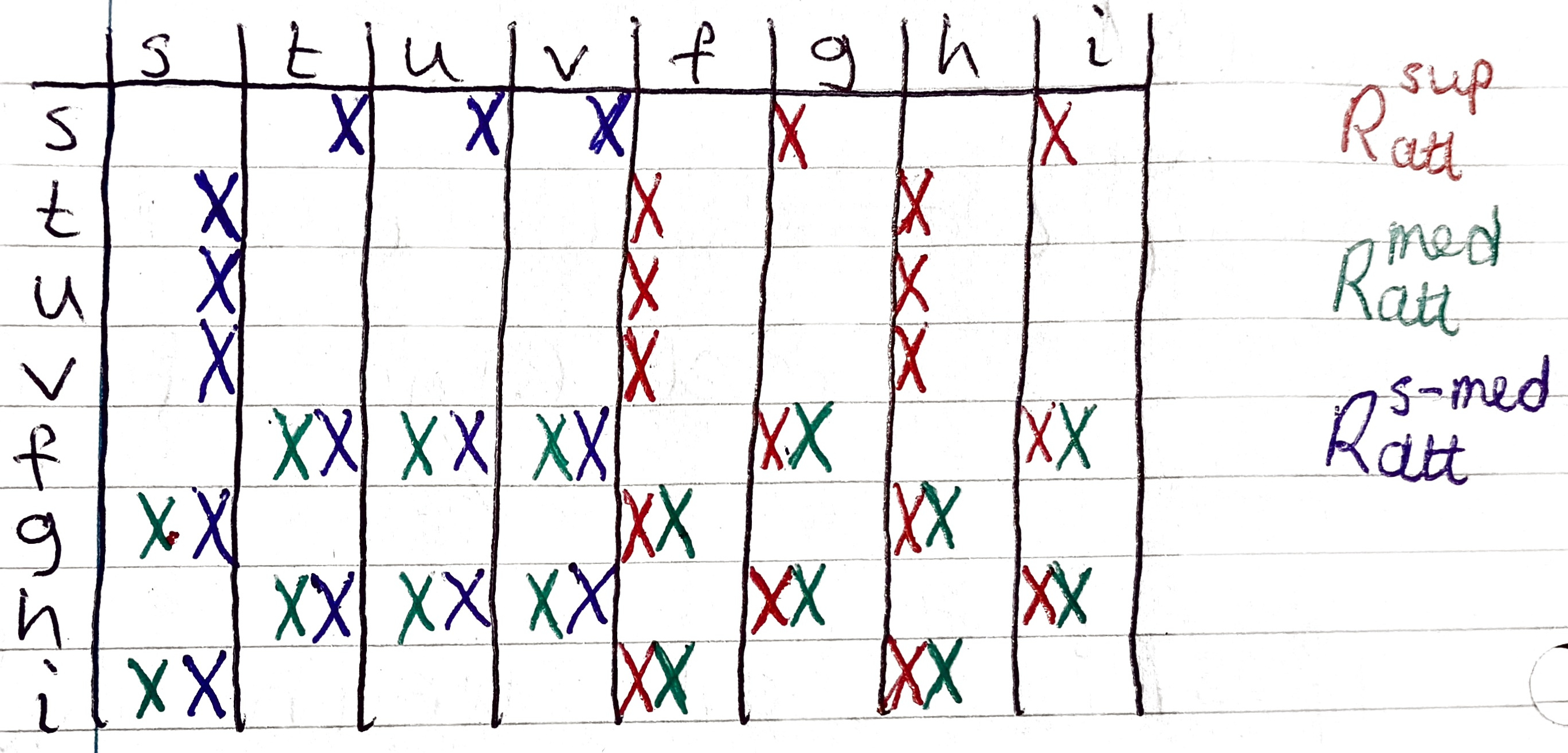
Figure 4
Do these attacks make sense for truth discovery?
To investigate this, let us consider a more interesting TD BAF where sources \(s\) and \(t\) agree on one object but disagree on another, as shown in Fig. 5.

Figure 5
There are two interesting points regarding the complex attacks generated here.
Self-attacking arguments. It can be seen that \(f\) attacks itself under \(\suppattack\), \(\secattack\) and \(\medattack\) (and similarly for \(g\)). For sources, it can be seen that \(s\) and \(t\) attack themselves under \(\smedattack\).
Inconsistency. We have both \(s \supp f\) and \(s \suppattack f\), i.e. \(s\) both supports and attacks \(f\). Similarly we have both \(f \supp s\) and \(f \smedattack s\).
Fig. 5 can be converted to a regular AF by discarding the supports and adding each type of complex attack. In principle one could also consider adding combination of different kinds of complex attack. Here the only such combination we shall consider is the supported attacks together with the super-mediated ones, since this is proposed in [CLagasquieSchiex13] in the case of the “deductive support” interpretation (where \(a \supp b\) means that \(b\) should be accepted whenever \(a\) is).
Adding mediated attacks. We have
That is, augmenting the attack relation with mediated attacks results in \(f\) and \(g\) attacking all arguments (including themselves).
In this case there are no admissible extensions, so no conclusions can be drawn.
Adding supported attacks. We have
That is, in all arguments attack \(f\) and \(g\). It can be seen that in this case \(\{s, t, h\}\) is an admissible, grounded, preferred and stable extension. It is interesting that \(s\) and \(t\) are accepted when they support (and attack!) non-accepted arguments \(f\) and \(g\) respectively. As will be seen below, this is remedied by additionally adding the super-mediated attacks.
Adding secondary attacks. For secondary attacks we have
This is the same as for mediated attacks; consequently no conclusions can be drawn.
Adding super-mediated attacks. We have
That is, all arguments attack \(s\) and \(t\), and \(f\) and \(g\) attack each other.
Here there are two preferred extensions: \(\{f, h\}\) and \(\{g, h\}\). Note that both are stable. The grounded extension is \(\{h\}\).
Adding supported and super-mediated attacks. We have
That is, all arguments attack every other argument except \(h\). It is easy to see that \(\{h\}\) is the only conflict-free set, and it is admissible, grounded, preferred and stable.
TODO IN THIS SECTION:
Attempt a proof for the conjecture after the proposition
Look at safe and closed for \(\supp\) extensions from [CLagasquieSchiex13], and the semantics defined in terms of these concepts
Look at the meta-argumentation semantics defined in [BGvdTV10]
Look at the coalition meta-argumentation approach from Cayrol and Lagasquie-Shiex
Look at all the semantics I’ve discussed:
Extensions of \(\attack \cup \suppattack \cup \smedattack\) (but which Dung semantics? Just \(\subseteq\)-maximal conflict-free sets?)
Ones from the above bullet points
Define a TD operator using these and try to characterise it in the TD language
Gradual semantics
Extension-based semantics suffer from an “all or nothing” character: arguments are either absolutely accepted or absolutely rejected. This behaviour is not appropriate in all situations, and truth discovery is an example. 6 Indeed, consider the BAF in Fig. 5. Whilst \(h\) should certainly be accepted, and it can be argued that \(f\) and \(g\) should be “half-accepted”, but this is not possible with classical argumentation semantics.
To achieve the desired granularity in the acceptance of arguments, we can turn to gradual argumentation. A gradual argumentation semantics assigns to each argument a value \(v \in \mathcal{V}\) where \(\mathcal{V}\) is some totally ordered set (often \([0, 1]\)). A related notion is ranked semantics which assigns to each argumentation framework a total preorder on the set of arguments. In both cases arguments are not given an absolute status (accepted/rejected) but measured against each other on the basis of how acceptable they are.
Next we review existing gradual/ranked argumentation semantics from the literature. Broadly there are two options for doing so: we can either convert the TD BAF to a regular AF (as in the previous section) and apply gradual semantics, or use gradual semantics defined explicitly for bipolar frameworks. The former approach yields many more semantics, but relies on choosing appropriate complex attacks to convert to a unipolar framework. We start with semantics from the latter approach.
Local Gradual Valuation
[CLS05a] define the local graduation valuation family of semantics, wherein the valuation of an argument is given by combining the valuations of its supporters and attackers. Two specific instances are given, which are termed LocMax and LocSum in [BRT19]. Note that since we allow BAFs with cycles, neither LocMax nor LocSum define a unique semantics.
In what follows, for a relation \(R \subseteq X \times X\) let us write \(R^-(x) = \{y \in X : y R x\}\) and \(R^+(x) = \{y \in X : x R y\}\). Then \(\supp^-(a)\) is the set of arguments supporting \(a\), \(\attack^+(a)\) is the set of arguments attacked by \(a\), etc.
With the restriction that \(\sigma\) maps into \([-1, 1]\), there are TD BAFs for which no LocMax valuation exists. Indeed, consider the TD BAF from Fig. 3, and suppose some \(\sigma\) satisfying (1) exists. Then we have the following system of equations, where for brevity we abuse notation by writing \(s\) for \(\sigma(s)\) etc.
First note that from (4), (5) and (6) we get \(t \ge i + 1 = u = v\). Consequently \(\max\{t, u, v\} = t\) and, from (10), \(i = t - h\).
Next, from (7) and (8) we get \(s = f + g = t\). This means
and hence \(i = t - h \ge 1\); but since \(i \in [-1, 1]\) this means \(i = 1\). Finally, this means \(u = v = i + 1 = 2 \notin [-1, 1]\), which is a contradiction.
Without the restriction that valuations lie in \([-1, 1]\), the above system of equations does have solutions, e.g. for any \(x \ge 2\) take \(s = t = x\), \(u = v = 2\), \(f = 1\), \(g = h = x - 1\) and \(i = 1\). 7 However it is difficult to justify adding 1 in (3) - (6) in this case.
TODO: is it worth investigating LocSum?
- 1
Note that the original sources do not use the notion of the transitive closure, and instead spell out the details of a chain of supports. I am pretty confident the definition with the transitive closure is equivalent.
- 2
Note that [BGvdTV10] disagrees with the secondary attack notion from [CLagasquieSchiex13], claiming that it leads to inconsistencies.
- 3
Secondary attacks are called indirect defeats in [CLS05b].
- 4
This is because in the definition of a mediated attack we allow indirect support from \(b\) to \(c\) (i.e. we use \(\trcls{\supp}\)) whereas for a super-mediated attack a direct support is required (i.e. we use \(\supp\)).
- 5
It’s possible that this terminology is a bit silly and/or pretentious…
- 6
See [ABN13] for more discussion around why extension-based semantics are not always appropriate.
- 7
In this solution \(f \le h\); I think there are also solutions where \(h < f\).